
Madison City Directory Shelves
Madison directory volumes survive through overlapping digital, library, and archival collections. UW provides the clearest verified online run. Central Library holds local printed material and later reverse directories. Wisconsin Historical Society adds microforms and reference holdings, while HeritageQuest broadens a search beyond one publisher. No official year-by-year publisher inventory was verified, so a shelf gap should be checked with staff instead of filled by assumption.
| Collection | Years | Where Held | Access |
|---|---|---|---|
| UW Madison directories | 1858-1921 advertised | UW Digital Collections | Free scans; search varies by item |
| Williams' Madison volume | 1859-1860 | UW item-level scan | Free digital volume |
| City directory and business advertiser | 1871-1872 | UW item A443IPQCGWDUQM8F | Free scan and catalog record |
| Madison volume 9 | 1904 | UW item ADDXA6VLHTXELY8H | Free page-image volume |
| Printed and reverse directories | Run varies | Central Library, second floor | Local History and Local Materials |
| HeritageQuest directories | 1821-1989 corpus | Madison Public Library eResources | Library authentication likely |
| WHS Madison holdings | Varies by catalog item | WHS library and microforms | Onsite reference access |
The UW Digital Collections directory collection should be checked volume by volume. Save the title, year, page, and stable item identifier with each find. Optical character recognition, the text used for keyword search, may vary, so browsing the alphabetical pages can succeed after a text search fails.
Madison Directories From 1858
The digitized run begins with Madison's early growth. A Williams' volume from 1859-1860 is identified in UW's catalog trail. The official 1871-1872 title describes names and residences along with a business directory, public officers, societies, and institutions. The 1904 volume includes general, street, and classified-business sections, a revised city map, and wives' names on the same line as husbands.
Those differences matter. A surname-only search may miss a business filed under its firm name, while a street section can reveal the form of an address used that year. Read the title page and contents before moving to an entry. Cite a downloaded page as a historical snapshot, not a current statement about a person or place.
Note: The collection advertises 1858 through 1921, but availability and searchable text must be confirmed in each scanned Madison volume.
Madison Library Directory Research
Historic Madison's research guide sends directory researchers to Central Library at 201 W Mifflin Street. The Local History Room and Local Materials section at the end of the second-floor Reference stacks hold the local volumes. Reference staff can also point to a name-and-subject clipping file and newspaper microfilm.
The Wisconsin State Journal, Capital Times, and other Madison newspapers are available on microfilm, with readers and printers for copies. The local State Journal index covers May 1966 through April 1996. Index coverage is not the same as full-text newspaper coverage, so a missing name may still require browsing an issue near a known event date.
HeritageQuest Madison Directory Searches
Madison Public Library's HeritageQuest access includes about 1.5 million city and county directories dated 1821 through 1989. It also brings census images from 1790 through 1940, family and local histories, a public-record index covering 1950 through 1993, and land-ownership plats into the same research setting. Print, email, and download tools are advertised; library-card authentication is likely required.
HeritageQuest is broader than the local shelf, but broad coverage does not promise every Madison year. Try initials, a spouse's name, a business, and variant street spellings. When a result supplies an image, preserve the page rather than relying only on the search transcript.
Read a Madison Directory Entry
A Madison directory entry is compact and edition-specific. The same line may mix a resident's name, spouse, occupation, employer or office, and residence. Widow or owner and renter marks appear in some volumes. Business pages may name a company, officers, and address. Always photograph or save the abbreviation key before translating a symbol.
| Volume and page | The source citation needed to find the entry again |
|---|---|
| Name line | Surname, given name, initials, and sometimes spouse or relationship |
| Work line | Occupation, business, employer, or office address when printed |
| Residence | House number, street, and possible unit or boarding notation |
| Status marks | Owner, renter, widow, or other symbols when that publisher uses them |
- Criss-cross directory
- A section arranged by street address, used to turn a known location into a name or telephone lead.
- Householder index
- An address-based list of the person selected by the publisher to represent a household.
- Abbreviation key
- The volume's own list of shortened words and symbols, often printed in its front matter.
A householder label is not a census of every person at the address. Confirm relationships through census, obituary, vital, or probate sources when the research question requires them.
Reverse Madison City Directories
Later reverse or criss-cross volumes let an address lead the search. Find the exact street spelling and number, note the printed occupant or telephone listing, then move to the alphabetical part of the same directory. That second entry may add a spouse, business, or fuller name. Historic Madison notes a post-1950 pattern for these address tools, but the research did not verify a complete annual run.
Reverse searching is an insider method because it connects the two halves of one dated source. It is also useful when handwriting, a nickname, or an initial blocks a surname search. If the question concerns present ownership and adjoining parcels, switch to the Madison street directory, which owns the modern address-record chain.
Madison Streets in Custer Files
The Wisconsin Historical Society's Frank Custer Local History Research Files preserve clues that are not structured like a city directory. Call number M2001-157 covers 52 boxes of index cards. Madison subjects fill boxes 9 through 56, while boxes 57 through 59 cover street names from A to Z, including houses and street-name origins.
These cards can help when a directory address no longer matches a current map or when a building was known by another name. Treat the card as a lead and follow its cited source. WHS newspaper microforms, maps, and catalog records can then supply the dated evidence behind it.
Madison History Beyond Directories
The Dane County Historical Society keeps the Otto Schroeder Archives & Records Center in the lower level of the Lussier Family Heritage Center. Research is by appointment through danecountyhistory@gmail.com, and staff-assisted copying may cost time. Its PastPerfect catalog and digitized collections include plat maps, family-history booklets, and more than 1,500 Kronenberg architectural drawings.
Oral histories add context that a directory line cannot hold. More than 60 Historic Madison interviews, recorded in the 1980s through 1991 and digitized with local partners, discuss Third Lake, downtown, Bush, Regent, the Latin Quarter, and events such as the 1904 Capitol fire. Use an interview as attributed recollection, not proof that every detail occurred exactly as remembered.
Map a Madison Directory Address
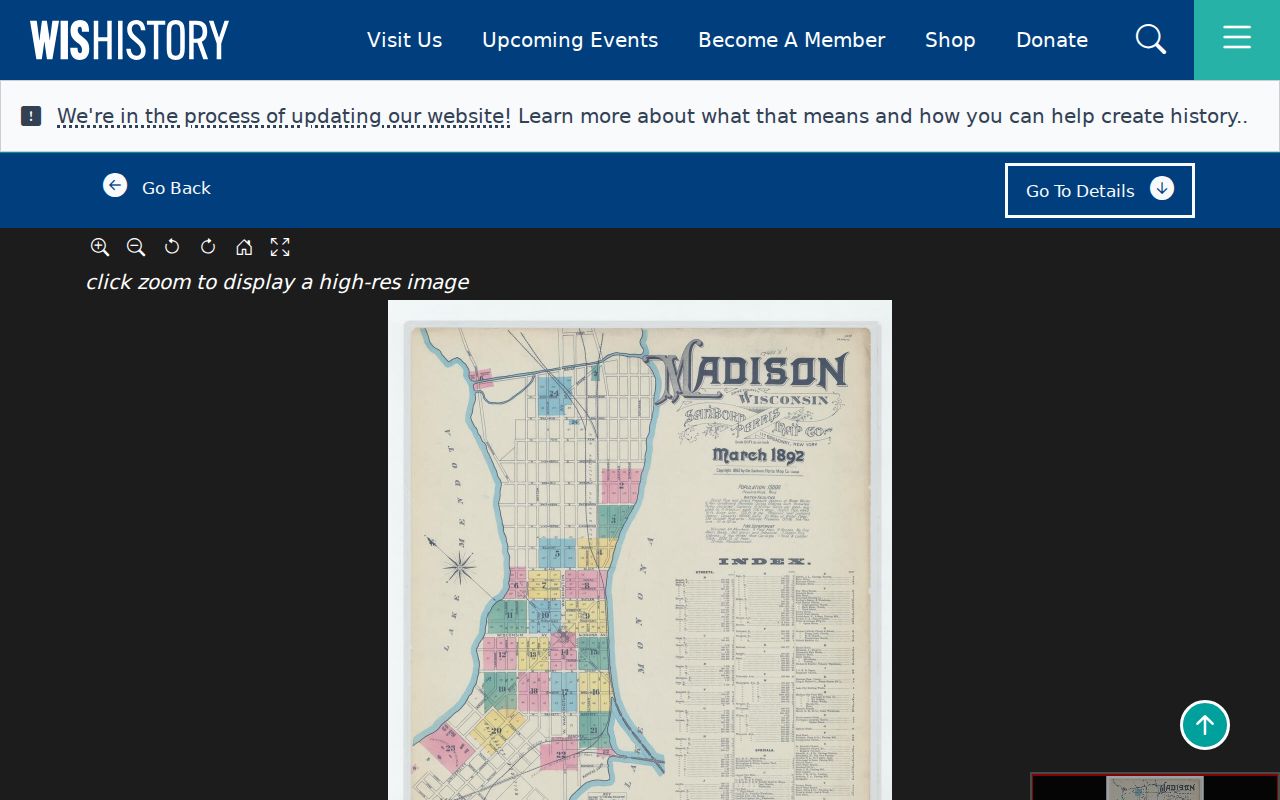
Maps test whether the same printed address refers to the same physical site across time. The verified March 1892 Madison Sanborn fire-insurance set contains 24 sheets. Sanborn maps show the built environment at a fixed date, while plats explain lot and block structure. Neither is a resident list, but both can reveal a changed number, demolished building, or subdivision that makes a directory trail look broken.
The Wisconsin Historical Society Sanborn record provides the catalog checkpoint for that set.
Trace Family With Madison Directories
Directory volumes fill years between federal censuses and can show a move in smaller steps. The census describes a household within a census boundary. A directory describes names, addresses, telephones, or businesses according to its publisher. Pair them, but do not force them to agree when municipal limits or street forms changed.
- Choose an address and approximate year. Search the reverse section, or obtain a surname from a deed, census, obituary, or assessor record.
- Read the full entry and key. Record initials, spouse, occupation, business address, residence, and all symbols.
- Move one available year backward and forward. Track each street spelling, direction, suffix, and unit change.
- Compare federal census images through the last open census under the 72-year rule. Reconcile city boundary changes.
- Search newspaper microfilm, the State Journal index, and the reference clipping file for a dated move, marriage, or death notice.
Disappearance from one volume can mean a move, death, omission, publication gap, changed name, or failed text recognition. A Forest Hill Cemetery burial result, obituary, later directory, or deed can distinguish those paths. Keep uncertain matches labeled as possible until a second dated source agrees.
Careful use. Historical directories support lawful family, street, and community research. They should never be used to harass or expose a protected person.