
Madison Previous Residents by Era
A Madison address has several timelines. The current parcel record anchors the search, while deeds connect one owner to the next. Reverse directories can turn an address into an occupant name. Ordinary city directories, census schedules, newspapers, maps, and permit files then fill the years between transfers. The best source depends on the date and whether the aim is to identify an owner, an occupant, or the structure itself.
| Source | Years It Covers | Where Held | What It Shows |
|---|---|---|---|
| Register of Deeds index | January 1975 forward on the index page; copy help says 1972+ | Dane County Register of Deeds | Grantors, grantees, instruments, document numbers, and many images |
| Reverse directories | Later printed directory years; exact local run varies | Madison Public Library and historical collections | Occupant or telephone leads arranged by address |
| City directories | Digitized Madison volumes advertised for 1858-1921; later print holdings | UW Digital Collections and Central Library | Names, residence, spouse, work, and occasional status marks |
| Federal census | Released schedules under the 72-year rule | HeritageQuest and federal archives | Household members and relationships within an enumeration area |
| Maps and city files | 1892 Sanborn checkpoint; permit coverage varies | Wisconsin Historical Society and Madison Accela | Building footprint, lot context, and address-linked work |
For a recent transfer, start online with the city parcel and county deed indexes. For an early twentieth-century question, go first to a directory volume and then match its address to the map and census. The Madison Public Library HeritageQuest resource brings census images, directories, local histories, and land plats together, though library-card authentication may be needed. Older gaps often require an office, library, or archive visit rather than another web search.
Anchor Madison Address Records
First identify the modern parcel through the City of Madison property search. Its address form takes a required house number and street name, plus optional direction, street type, and unit. Save the parcel number and the situs address, which means the physical location. Also copy the legal description, such as the lot, block, subdivision, or certified survey map reference.
Next compare the parcel in Access Dane. County results can add tax, assessment, zoning, district, acreage, and recorded-map details. A mailing address is where tax correspondence goes; it does not prove that the owner lived at the property. Access Dane also says some owners opt out of public display, and its Madison data can lag during city software deployments. An empty owner field therefore does not erase the parcel or its history.
Note: A parcel number and legal description survive many street-label changes, making them stronger links than a house number alone.
Trace Madison Resident Ownership Records
The Dane County real-estate record search is the main route from a current owner to earlier owners. Start with the latest recorded deed and preserve its document number, parties, recording date, and legal description. Then turn the seller into the next search name. Repeating that move builds a chain of title, the sequence of recorded interests in the same land.
- Copy the present owner, parcel number, and legal description from the assessor record.
- Find that owner's purchase deed and record the seller, known as the grantor.
- Search the seller as a grantee, the party who earlier received the property.
- Match the legal description before accepting the next deed, then repeat the search.
- At the online cutoff, use the Register of Deeds office, copy route, and older books.
- Grantor and grantee
- The grantor gives or transfers an interest; the grantee receives it.
- Chain of title
- The linked sequence of recorded transfers for the same land.
- Legal description
- The record's land identity, often based on lot, block, subdivision, survey, or boundaries rather than a postal address.
Madison Previous Residents Index Gap
Two official Dane County pages describe the web cutoff differently. The online-search page says the index begins in January 1975 and notes that back-indexing continues. The copy-help page says records recorded in 1972 or later may be searched online. Treat those dates as access instructions, not proof that an unreturned deed never existed.
This local mismatch is an important previous-residents tip. If a transfer should fall in the early 1970s, ask the office to verify it. The copy route works best with a party name, approximate year, property address, and legal description. In-office records are generally available to view at the City-County Building. Mail requests require strong identifiers, a money order, and a self-addressed stamped envelope; the county notes an approximate two-week path.
Online searching carries an $8.75 search charge even with no result, plus $1 for each page viewed or printed. Office copies cost $2 for the first page and $1 for each added page, with $1 more per certified document. Check the official page before ordering because access and charges can change.
Note: Preserve document numbers as soon as they appear; they make later image, counter, and mail requests much more precise.
Maps Date Madison Resident Records
A deed says who held an interest, while a fire-insurance map can show what stood on the lot. The Wisconsin Historical Society's March 1892 Madison Sanborn set contains 24 sheets. Its building footprints, street labels, and block layout offer a firm checkpoint for an early address, though the map does not name every resident.
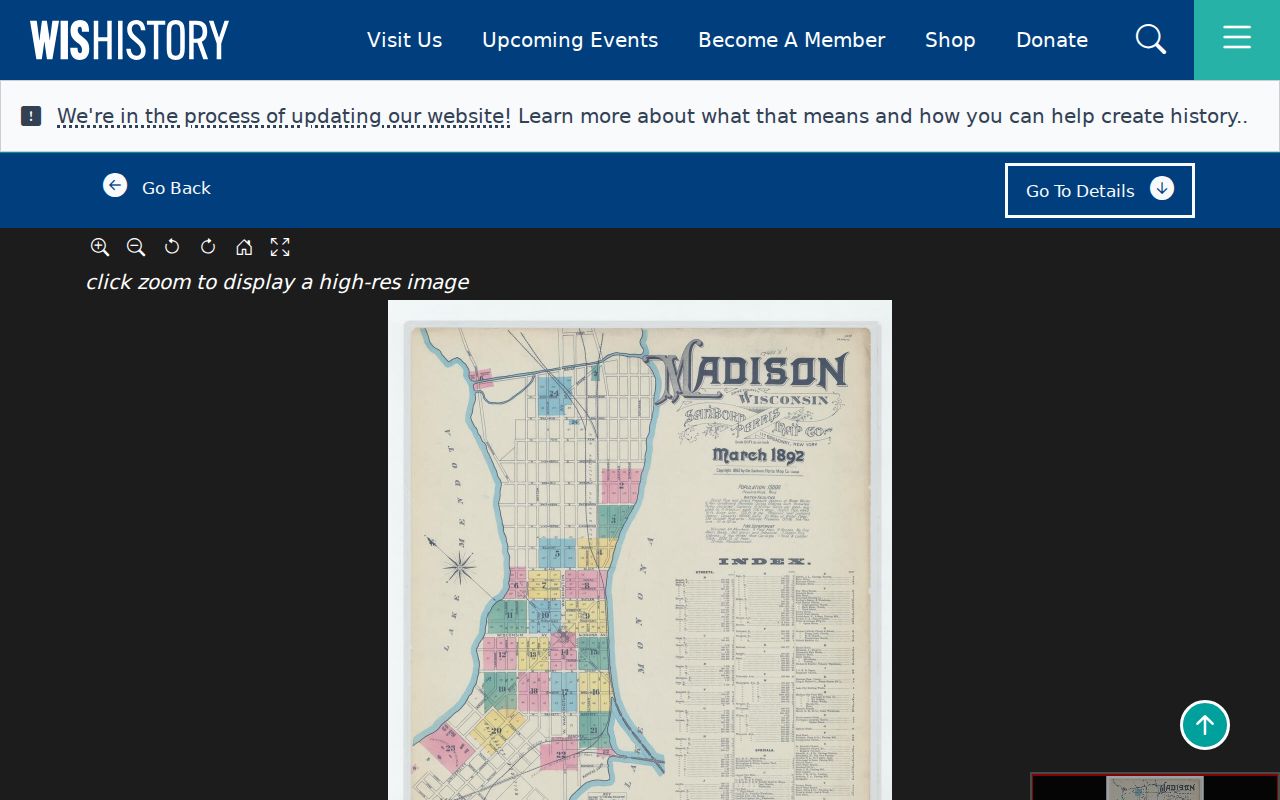
The map record helps separate a household move from a building change. Pair it with a plat, deed description, and directory entry rather than reading the image as an occupant list.
Madison Resident Records Land Bridge
A Dane County project described digitizing more than 500 mapped land records from 1937 through 1969, with coverage near west Madison, Shorewood, and Midvale. That work may bridge a paper-heavy span between printed sources and the modern online deed index. Because the searchable subset can change, confirm what is live before promising that a specific parcel appears.
For records still offline, combine the Register of Deeds counter with archive and map research. The Wisconsin Historical Society's Frank Custer Local History Research Files hold 52 boxes. Street names, houses, and street-name origins are concentrated in boxes 57 through 59 under call number M2001-157. Those cards can reconnect an old label with the modern parcel when a plain address search fails.
Madison Previous Residents Beyond Indexes
The Dane County Historical Society keeps architectural drawings, plat maps, family-history booklets, and other files at the Otto Schroeder Archives & Records Center. Research is by appointment, and staff copying may have a cost. Its PastPerfect catalog is a useful first check before contacting the archive.
More than 60 Historic Madison oral-history interviews recorded in the 1980s through 1991 were digitized with local partners. Their subjects include Third Lake, downtown, Bush, Regent, and the Latin Quarter. These accounts can explain an old neighborhood name, business, or building change. They are context, not a substitute for a deed or dated directory entry.
Madison Past Households in Print
Owners are only one part of a home's story. Reverse directories may list an occupant or telephone by address, and alphabetical entries can add a spouse, occupation, employer, or owner and renter mark. The digitized Madison run is advertised for 1858 through 1921, while Central Library holds later printed material. The collections and entry conventions are treated in depth on the Madison city directories page.
Use a simple flow: address and directory year, then name and alphabetical entry, then the nearest released census, followed by the next directory year. Census households and directory entries have different scopes, so record omissions and spelling shifts rather than forcing a match. Newspaper microfilm, the library clipping file, Forest Hill Cemetery records, obituaries, and probate files can close the trail after a death. Survivors named in a notice are leads, not proof of a current address.
- Find the exact address in a reverse directory, when that section exists.
- Read the named person's alphabetical entry and the volume's abbreviation key.
- Check the closest released census for household ties and the correct enumeration area.
- Move forward and backward one directory year, logging every change.
Lawful use. Research Madison previous residents for house history, family history, estate work, or personal curiosity. Never use an old address trail to track, intimidate, or harass a living person.